
January is full of people who overdo it. February is full of empty gyms.
You’ve probably seen that Instagram these days is full of “New year, new me” and ambitious programs for daily exercise, strict diets, and total lifestyle change. The problem? Research shows that about half of all those who start exercising in January have quit within six months.
But it doesn’t have to be you.
What the Research Actually Says About Exercise Habits
The good news is that we know quite a bit about what it takes to build lasting exercise habits. And it’s surprisingly not about willpower.
Research on habit formation shows that it takes an average of around 66 days for a new behavior to become automatic. But here’s the important thing: Frequency trumps intensity when it comes to establishing habits.
That means that three moderate workouts a week, done consistently over two months, build stronger exercise habits than six intense workouts that you give up after three weeks.
Why “Start Gently” Isn’t Laziness
It may feel backwards. You’re motivated now. Why not take advantage of it?
Because motivation is unreliable. It fluctuates with sleep, stress, weather, and mood. Systems and routines, on the other hand—they work regardless of whether you “feel like it.”
When you limit yourself to 2-3 workouts a week, you’re doing something smart:
- You reduce decision fatigue. Fewer workouts mean fewer days you have to decide to exercise. Even better? Book your classes in advance, so you don’t end up on the couch or at your desk instead.
- You build mastery experiences. Completing all planned workouts feels good. Constantly “missing” workouts undermines your self-confidence.
- You give your body time to recover. Especially if you’ve trained little, your muscles need rest between workouts to adapt.
The Practical Formula for Good Exercise Habits
Here’s a workout week that actually works for most people returning to exercise:
Day 1: Full Body Strength (30-45 minutes) Simple, basic exercises that activate the whole body. Focus on technique, not heavy weights.
Day 2: Rest
Day 3: Mobility + Light Strength (30-45 minutes) Mobility combined with strength exercises. Perfect for counteracting stiffness and building movement quality.
Day 4: Rest
Day 5: Optional Activity (20-45 minutes) Something you actually enjoy—dance, yoga, circuit training. Variation keeps motivation up.
Weekend: Active Rest A walk, light stretching, or simply free. Recovery is training too.
One Thing That Drastically Increases Your Chances
Research on behavior change points to one factor that consistently distinguishes those who succeed from those who don’t: external commitment.
Deciding to “exercise more” is vague. Signing up for a class at 6:00 PM on Monday is concrete. You have an appointment. Someone expects you.
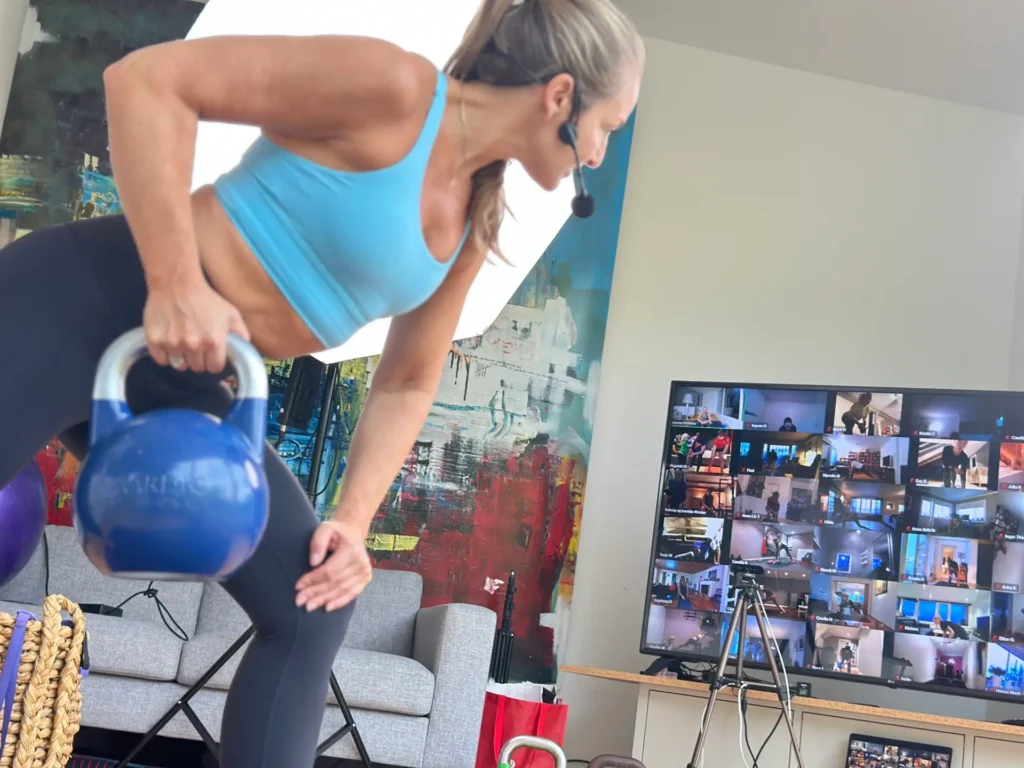
This is why live fitness classes—whether in a studio or online—have significantly higher attendance rates than the “I’ll exercise when I feel like it” strategy.
When you sign up for a class in advance, you remove the decision from the moment. You’ve already decided. All you need to do is show up.
What About Results?
Here’s the truth: Results don’t come from the perfect workout plan. They come from the plan you actually follow, week after week, month after month.
Two to three workouts a week, done consistently for a year, beats six workouts a week done for six weeks.
That doesn’t mean you should stay at 2-3 workouts forever. But it does mean you should start there. Once your body has adapted, once exercise has become part of your routine, when you no longer need to persuade yourself—then you can consider adding more.
The First 66 Days Create Exercise Habits
Think of January and February as the investment period. You’re not just building strength and fitness—you’re building a system that makes exercise automatic.
Here’s How to Maximize Your Chances of Success:
Choose Fixed Days and Times. “Tuesday and Thursday after work” is better than “twice a week.”
Sign Up in Advance. Do it Sunday night for the whole week. The deal is done.
Prepare the Night Before. Workout clothes laid out, bag packed. Remove friction.
Celebrate Showing Up. Not just when you “train well.” The very attendance is the victory.
Expect Setbacks. You’re going to miss a workout. That’s not the end. It’s just one day. The next workout awaits.
Not a Sprint—a System
It’s tempting to see January as the starting gun for an intense transformation. But lasting change is not a sprint. It’s a system you build gradually.
2-3 workouts a week is not “too little.” It’s just enough to build the foundation for exercise habits that last—not just until February, but until next January and the years after that.
Start where you are. Build slowly. Be the one who shows up.