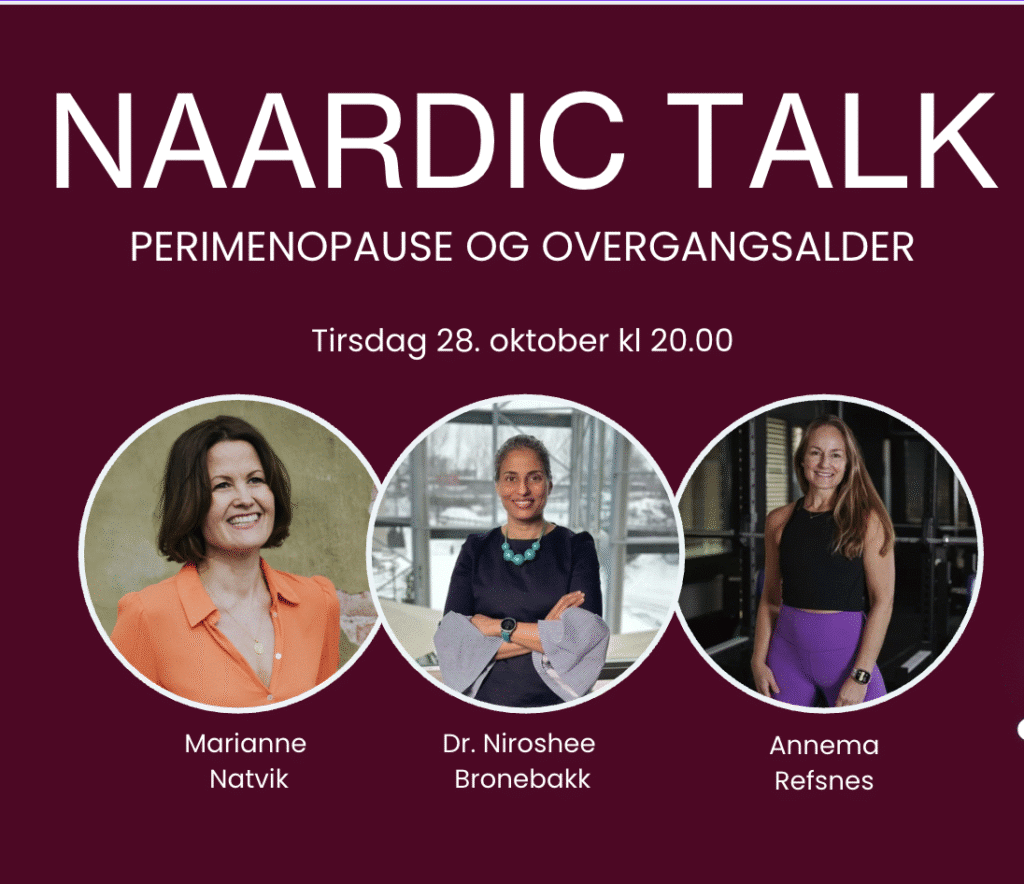

This article summarizes the conversation between our founder Annema, Dr. Marianne Natvik and Dr. Niroshee Bronebakk about why proper exercise is crucial for health and quality of life through menopause. You can find the recording on the schedule and in the video library.
Menopause is a natural phase of life that all women go through, but information on how to best manage this period is often conflicting, confusing, or simply wrong. To provide our members with evidence-based guidance, we invited two medical experts to a conversation about what the research actually shows.
Dr. Marianne Natvik is a general practitioner, researcher, and author of the book “Overgangskraft” (Menopause Power). She has dedicated her career to understanding and treating women in menopause, and actively works to raise the level of knowledge about this phase of life both in the healthcare system and in society in general.
Dr. Niroshee Bronebakk is a chief physician, researcher, and founder of Clinic for Healthy Aging. Her focus is on preventing lifestyle diseases such as heart disease, dementia, diabetes and cancer through evidence-based interventions.
Together they gave us insight into three critical areas:
- What actually happens in the body when hormone levels change
- Which forms of exercise are most effective in counteracting negative effects
- Why common advice (such as intermittent fasting) can be directly harmful in this phase
This article summarizes their most important messages, with extended quotes and practical advice on how you can implement their recommendations in your everyday life. If you want to see the whole conversation, you can find it in the schedule under Naardic Talks.
Part 1: What happens in the body during menopause
The phases of menopause – what you didn’t know
Dr. Marianne Natvik starts by defining what menopause actually is:
“Menopause is a natural phase of life that all women go through in midlife, where the ovaries gradually produce fewer hormones.”
She explains that there are three distinct phases:
- Perimenopause: The time before the last menstruation, when symptoms often begin (can last 4-10 years)
- Menopause: Last menstruation (defined retrospectively after 12 months without menstruation)
- Postmenopause: The time after the last menstruation (rest of life)
The critical point that many do not know: Symptoms and bodily changes often begin long before the last menstruation. You don’t have to wait to do something. In fact, it is precisely in perimenopause that intervention can have the greatest effect.
Hormonal changes affect the whole body
Dr. Niroshee Bronebakk explains the scope of the hormonal changes:
“When hormone levels drop, large parts of the body are affected because we have hormone receptors in many cells.”
This is not just hot flashes and irregular bleeding. She describes a cascade of physiological changes that affect almost all body systems:
Cardiovascular changes:
- Blood vessels become stiffer and less elastic
- Increased risk of cardiovascular disease (risk quadruples after menopause)
- Blood pressure may increase
- The cholesterol profile changes negatively
Metabolic changes:
- The body becomes less sensitive to insulin
- Blood sugar levels gradually increase
- The body begins to store fat instead of using it as energy
- Fat storage shifts from hips/thighs to the abdominal area (visceral fat)
- Metabolism is reduced by up to 200-300 calories per day
Muscular changes: “Muscle function changes – the muscles become weaker and you lose muscle mass.”
This is not just an aesthetic problem. Dr. Bronebakk explains the critical connection:
“The less muscle you have, the less storage space for glucose, and the excess is stored as fat around the stomach.”
This muscle-metabolism link is fundamental: Muscles function as the body’s glucose “bank”. When this bank shrinks, blood sugar has nowhere to go – and is instead stored as dangerous belly fat.
Stress response and sleep:
- Stress hormone levels (cortisol) increase
- One becomes more easily stressed by everyday situations
- Sleep quality is significantly reduced (deeper sleep phases disappear)
- Night sweats can further disrupt sleep
- Increased cortisol inhibits muscle building and promotes fat storage
Other critical changes:
- The bacterial flora in the gut changes, which can contribute to weight gain and inflammation
- Mucous membranes become drier, increasing the risk of urinary tract infections
- The joints become stiffer due to reduced collagen production
- Bone density is reduced by 1-2% annually after menopause
- The skin loses elasticity faster
- Hair may become thinner
Symptoms beyond the physical
The host in the conversation brings up that many women experience that they “lose themselves” in menopause. Dr. Marianne Natvik responds with an important nuance:
“It is important to sort out what is due to hormones and what may be other factors or diseases. Many women in this age can also have metabolic diseases or other diagnoses that complicate the picture.”
Dr. Bronebakk emphasizes that the symptom picture is much broader than the classic symptoms:
Cognitive symptoms:
- Concentration problems (“brain fog”)
- Memory problems (especially working memory)
- Word-finding difficulties
- Reduced multitasking ability
- Impaired decision-making ability
Emotional symptoms:
- Depression for no apparent reason
- Anxiety-related symptoms (even without previous history)
- Irritability and mood swings
- Loss of self-confidence
- Feeling of “losing oneself”
Physical symptoms beyond the obvious:
- Heart palpitations without exertion
- Joint pain and stiffness (especially in the morning)
- Headache and migraine (may worsen)
- Dizziness
- Tingling sensation in extremities
Dr. Natvik adds a critical observation:
“Many women experience more powerful premenstrual symptoms in perimenopause, and some can become so depressed that they do not recognize themselves.”
This is important because women often do not link these symptoms to menopause, especially if they still have menstruation.
Part 2: The exercise prescription – three essential forms of exercise
This is the core of the experts’ message: Not all exercise is equally effective in menopause. Dr. Bronebakk is crystal clear in her recommendations, and her prescription is based on extensive research.
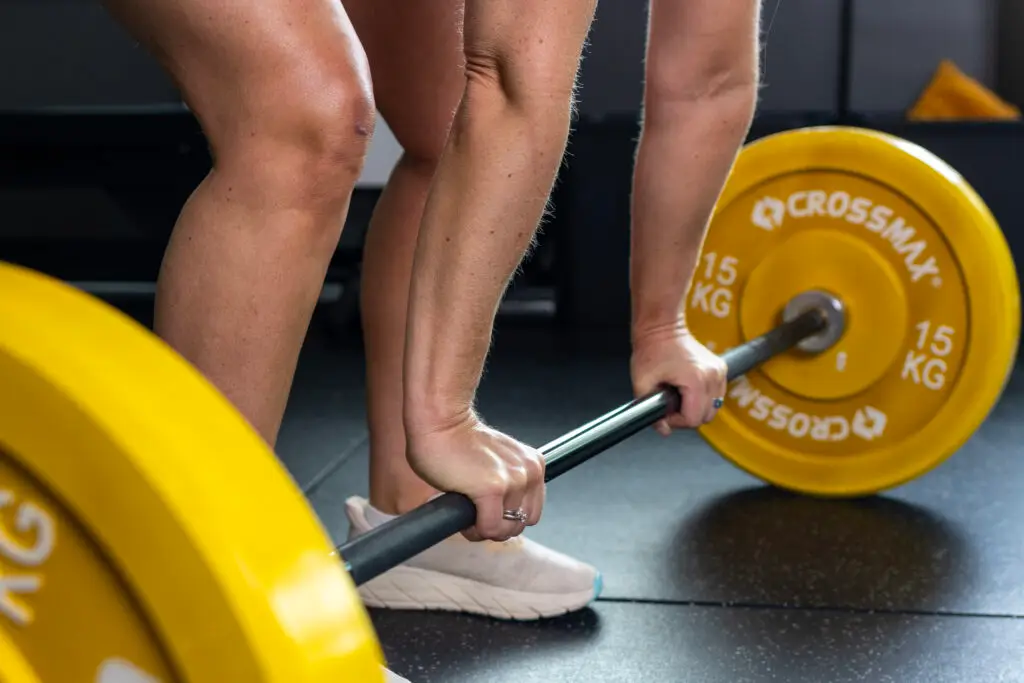
1. Strength training with heavy weights (primary focus)
Dr. Bronebakk explains:
“I recommend three types of exercise: strength training with heavy weights and few repetitions to build muscles…”
She specifies the importance of the load:
“It is important to lift heavy to send signals to the brain to build muscles.”
But what does “heavy” really mean?
This is a critical question many women have, especially those who have never trained strength before. Fortunately, the experts address this directly.
Dr. Natvik explains with empathy:
“It doesn’t have to be heavy weights we’re talking about, but it’s a load that makes you feel you have to work. For someone who has never done strength training, it will be heavy to use their own body weight. For another, it may be heavy to use a resistance band.”
Dr. Bronebakk adds the scientific perspective:
“It is very important with progressive overload. You must gradually increase the resistance so that you gradually improve muscle mass.”
Why is this so critical in menopause?
It’s about much more than just strength. Dr. Bronebakk explains the metabolic connection:
“The less muscle you have, the less storage space for glucose, and the excess is stored as fat around the stomach.”
Muscle mass is therefore your metabolic “bank” for blood sugar control. When this is reduced in menopause, the risk increases dramatically for:
- Abdominal obesity (dangerous belly fat)
- Insulin resistance
- Type 2 diabetes (risk doubles)
- Metabolic syndrome
- Cardiovascular disease
- Osteoporosis
The research shows clear results:
Studies show that women who strength train 2-3 times per week through menopause:
- Retain or increase muscle mass
- Reduce belly fat
- Improves insulin sensitivity
- Increases bone density or slows the loss significantly
- Reduces the risk of falls
Is strength training wasted if it is not “heavy enough”?
A question from the audience addressed a common concern: “Is strength training wasted if it is not heavy enough?”
Dr. Bronebakk answers nuanced:
“No training is wasted. If you go from doing nothing to doing something, it’s better than nothing. But to get the changes that make you live longer with a good quality of life, it is important with progressively heavier load.”
She elaborated on this important point:
Of course, all movement is better than nothing, and it is good for your health to move. But if you want change that makes you live long with good function, you must train with progressive overload.
2. Interval training for heart protection
Dr. Bronebakk recommends:
“Interval training is important to protect the heart.”
But here comes a critical nuance that goes against much common training advice:
“Interval training should be short and intense – 30 seconds with 100% effort, 4 minutes break – instead of long, moderate sessions that only increase the stress hormone.”
This is incredibly important: Long, moderate cardio sessions can actually work against their purpose in menopause, because they further increase cortisol (stress hormone), which is already elevated.
Important: This does NOT replace long, quiet walks or runs – they have their place for mental health and general activity. But for specific heart protection and metabolic improvement, short intervals are superior.
3. Yoga or similar for stress reduction
The third pillar in Dr. Bronebakk’s recommendation:
“Yoga or similar to reduce stress and improve sleep quality.”
This is not about “wellness” or “mindfulness” as buzzwords – there is solid science behind it.
Why stress reduction is critical in menopause:
Dr. Bronebakk explains:
“In menopause we already have higher cortisol. Stress exacerbates all the symptoms.”
Elevated cortisol:
- Breaks down muscle mass
- Increases fat storage around the stomach
- Disrupts sleep
- Inhibits bone health
- Worsens hot flashes
- Reduces sex drive
- Weakens the immune system
Yoga and similar activities counteract this by:
- Reduce stress hormones
- Improve sleep quality (especially deep sleep phases)
- Increase flexibility and balance
- Reduce joint pain
- Improve mental clarity
- Support pelvic floor muscles
Specific yoga positions for menopause:
- Restorative positions (hold 3-5 minutes):
- Supported child’s pose (for stress reduction)
- Legs-up-the-wall (for circulation and swelling)
- Supported bridge (for pelvic floor and back)
- Balance positions (for bone health):
- Tree pose (vriksana)
- Warrior III (virabhadrasana III)
- Half moon (ardha chandrasana)
- Strength-building positions:
- Plank variations
- Downward-facing dog
- Warrior sequences
Alternatives to yoga:
Dr. Bronebakk says “yoga or similar” – she is not dogmatic. Other effective alternatives:
- Tai chi (documented effect on balance and bone health)
- Pilates (especially for core and pelvic floor)
- Structured stretching with breath control
- Calm swimming (but not too intense)
- Meditative walking in nature
Part 3: The nutrition trap – why intermittent fasting is dangerous now
The controversial truth about fasting
Dr. Bronebakk comes with a warning that goes directly against one of the most popular health trends:
“We already have higher cortisol in menopause. If we exercise without food, we make that workout give us even higher cortisol.”
This is critical information that few women know. Intermittent fasting, which works well for many younger people or men, can be directly harmful to women in menopause.
Why fasting is problematic in menopause:
- Cortisol cascade:
- Cortisol is already elevated by 20-30%
- Fasting increases cortisol further
- Exercising without food doubles the cortisol response
- The result: muscle breakdown, fat storage, poorer sleep
- Hormone disorders:
- Fasting can reduce thyroid hormone
- Can worsen estrogen deficiency symptoms
- Disrupts leptin and ghrelin (hunger/satiety hormones)
- Metabolic braking:
- The body goes into “saving mode”
- Metabolism is reduced
- Muscle loss accelerates
Dr. Bronebakk is clear: “Do not exercise on an empty stomach in menopause.”
The protein requirement no one talks about
Dr. Bronebakk gives a concrete recommendation that surprises many:
“I recommend a daily intake of 1.5 grams of protein per kilogram of body weight.”
For a woman of 70 kg, this means 105 grams of protein daily – significantly more than most get.
Why so much protein?
In menopause, several things happen at the same time:
- Muscle protein synthesis is reduced by 30%
- The body becomes less efficient at using protein
- Without enough protein, muscle loss accelerates
- Protein has the highest thermal effect (burns calories during digestion)
Timing is everything
Dr. Bronebakk explains the importance of food timing:
“Eat before and after training to avoid stress response and support recovery.”
Our trainer and nutritionist Anne Wangensteen has written about this previously, see her tips and recipes here.
Before training (30-60 minutes before):
- Easily digestible carbohydrate + some protein
- Example: Banana with almond butter
- Example: Oatmeal with berries
- Avoid: Large, fatty meals
After training (within 30 minutes):
- Protein + carbohydrates for optimal recovery
- Example: Protein shake with banana
- Example: Greek yogurt with granola
- Example: Chicken sandwich
Throughout the day:
- Even distribution of protein (not all in one meal)
- Eat every 3-4 hours for stable blood sugar control
- Do not skip meals
The sweet tooth strategy
Dr. Bronebakk and Natvik also discuss sweet cravings, which many experience increases dramatically:
“Try drinking a glass of water first – thirst can be mistaken for hunger.”
Their practical tips:
- Water first: Drink a large glass of water and wait 10 minutes
- Protein snack: If still hungry, choose a protein-rich snack
- Fiber focus: Foods with fiber provide longer satiety
- Accept cycles: “Sweet cravings right before menstruation is normal – the body wants carbohydrates”
- Be kind to yourself: “Don’t be too hard on yourself that week”
Smart swaps for sweet cravings:
- Dark chocolate (70%+) instead of milk chocolate
- Dates with almond butter instead of candy
- Frozen grapes instead of ice cream
- Protein pudding instead of regular dessert
Part 4: Psychosocial challenges and solutions
When symptoms affect your life
Dr. Natvik addresses a critical topic:
“Many women experience stronger premenstrual symptoms during perimenopause, and some may become so depressed that they don’t recognize themselves. Symptoms such as anxiety, difficulty concentrating, and ‘brain fog’ can often be mistaken for stress.”
She emphasizes the need to differentiate:
“It’s important to sort out what is due to hormones and what may be other factors or illnesses.”
When should you seek help?
Dr. Natvik is clear: “Symptoms deserve to be taken seriously when they affect your quality of life.”
Seek professional help if you experience:
- Depressive symptoms that last for more than 2 weeks
- Anxiety that affects daily functioning
- Sleep problems over a long period
- Cognitive problems that affect work
- Suicidal thoughts (seek help immediately)
Work life and accommodation
The program host points out that England has introduced guidance for employers on how to accommodate women going through menopause.
Dr. Natvik responds:
“Bergen municipality has done a good job in this field in Norway, and there is a research group in Bergen that studies menopause and working life.”
Practical measures in the workplace:
- Temperature control:
- Ask for a fan or placement near a window
- Have extra changes of clothes available
- Dress in layers
- Flexibility:
- Ask for flexible working hours if sleep is poor
- Opportunity for home office when symptoms are severe
- More frequent breaks for concentration problems
- Openness (if you are comfortable with it):
- Share challenges with your immediate manager
- Ask for support from HR
- Find allies among colleagues
Dr. Natvik encourages:
“Be open about your challenges at work and ask for accommodation if needed.”
Communication with partner and family
Dr. Natvik recognizes how difficult this can be:
“It can be very difficult to bring up menopause with your partner and family. If you lack the words to explain what you are experiencing, it can help to share podcasts, books, or articles that describe the symptoms.”
Concrete communication strategies:
With partner:
- Choose a quiet time (not in the middle of a conflict)
- Use concrete examples: “When I wake up sweaty at night…”
- Ask for specific support: “It would help if you…”
- Share resources: podcasts, articles like this one
With children:
- Adapt the information to their age
- Explain that mom is going through natural changes
- Reassure them that it’s not their fault if you’re irritable
- Ask for patience and understanding
With friends:
- Find like-minded people – many are going through the same thing
- Start a “menopause club”
- Share experiences and tips
- Support each other
At work:
- Start with HR or the occupational health service
- Focus on practical solutions, not symptom details
- Document if symptoms affect productivity
- Know your rights
Part 5: From theory to practice – your roadmap to success
The importance of professional guidance
Dr. Bronebakk warns from experience:
“There are many women who have never lifted before, and then suddenly go in and lift with heavy weights. You’re going to hurt yourself. So it’s very important with progressive overload – start by training with others who can help you.”
Dr Natvik also adds something essential about motivation:
“I’m a little concerned about the joy of movement. You have to find something that you like, that makes you want to do it again and again. And then we have to remember why we thought it was so lovely afterwards, so we sign up again.”
Why self-taught training often fails:
- Technique errors: Without guidance, many develop compensation patterns that lead to injuries
- Incorrect progression: Too rapid or too slow increase
- Lack of structure: Random training gives random results
- Loss of motivation: Alone, it is easy to give up when it gets tough
- No feedback: You don’t know if you’re doing things right
Common mistakes to avoid
1. “All or nothing” mentality. Dr. Bronebakk reminds us: “No training is wasted.” The biggest mistake many make is thinking that if they can’t train “perfectly” or follow the plan 100%, then it’s not worth doing anything at all. The reality is that you have to start small and build consistency before intensity. Gradual build-up over time gives lasting results, while throwing yourself into an extreme regime often leads to injuries or burnout.
2. Comparing yourself to others. “For someone who has never done strength training, it will be difficult to use their own body weight,” says Dr. Natvik. This underscores a fundamental truth: your “heavy” is right for you, no matter what others lift. Progression is deeply personal and depends on your starting position, genetics, and life situation. Focus on your own development from week to week, not on what the woman next to you can do.
3. Ignoring pain. It is critical to understand the difference between different types of discomfort. Muscle soreness the day after training is completely normal and actually a sign that the muscles are responding to stimuli. Joint pain, on the other hand, is not normal and should be taken seriously. If you experience sharp, stabbing pain during training, stop immediately – this is the body’s alarm signal that something is wrong.
4. Skipping recovery. Many do not understand that muscles actually grow at rest, not during the training itself. Training breaks down muscle tissue, and it is in the recovery period that the body builds them up again, stronger than before. You need a minimum of 48 hours between strength sessions for the same muscle group. Sleep is also critical for recovery – it is when you sleep that growth hormone is released and repair processes accelerate.
5. Underestimating nutrition. As Dr. Bronebakk emphasizes: Protein is not optional during menopause. Many women train hard but don’t see results because they don’t eat enough, especially not enough protein. Success requires meal planning, food prepping on weekends, and always having backup options ready for busy days. Training is stimulus, but nutrition is the building blocks for change.
What you can expect with strength training
During the first month, you may begin to notice small but important changes. Sleep quality often improves first – you wake up more rested and sleep deeper through the night. Energy levels throughout the day stabilize, and the typical afternoon fatigue becomes less intrusive. The mood is noticeably lifted, and the morning stiffness that many experience during menopause begins to subside.
Eventually, the physical changes become more visible. Clothes begin to fit better around the waist and hips, even if the weight may not have changed dramatically. Everyday activities such as carrying shopping bags or walking up stairs suddenly feel easier. Many report fewer and milder hot flashes, and the mental fog clears – concentration sharpens and you feel more mentally present.
When motivation fails
Dr. Bronebakk has a brilliant solution:
“We have to make an appointment and sign up, so we actually do it. The desire to train comes afterwards, when we know how lovely it was last time.” Find a friend who has similar training goals, or sign up for a class.
Strategies for sustained motivation
External commitment is one of the most effective strategies for maintaining a training routine. Sign up for regular classes where instructors and fellow trainees expect to see you. Find training friends who hold you accountable, or invest in personal training or group classes where you have a financial and social commitment to show up. When others are counting on you, it becomes harder to find excuses.
Track your progress consistently to see the actual development that is happening. Log weights and repetitions in each session so you can see the strength increase in black and white. Also note energy levels and symptom changes; these subjective improvements are often the most meaningful and motivating.
The celebration of small victories cannot be underestimated. Every single workout you complete is a victory that deserves recognition. Every extra kilo you manage to lift represents concrete progress. Every night with better sleep is proof that the effort works. These small victories build momentum and self-confidence over time.
Perhaps the most important thing is the mindset shift that must happen for long-term success. Change your language from “I have to train” to “I get to train” – it is a privilege to be able to move your body. When the training feels hard, remind yourself that “I am getting strong” instead of dwelling on how hard it is. And the classic excuse “I don’t have time” must be replaced with the truth: “I prioritize my health.” These mental reformulations change training from duty to investment in quality of life.
Part 6: The most important things doctors want you to remember
About menopause
Timing is critical for how you handle this phase of life. Symptoms often start in perimenopause, which can begin several years before your last menstruation. The biggest mistake women make is waiting until menopause is a fact before they act. Early intervention gives dramatically better results – both for symptom control and long-term health.
Your whole body is affected by the hormonal changes, not just the reproductive system. This is about much more than hot flashes and irregular bleeding. Metabolism changes fundamentally, muscle mass is reduced, bone density weakens, the heart becomes more vulnerable, and even the brain is affected. These symptoms deserve to be taken deeply seriously because they affect every single part of your life.
You deserve professional help through this transition. As Dr. Natvik says: “Don’t grit your teeth.” This is not an ordeal you should endure in silence. Seek medical help when the symptoms affect your quality of life. For many women, hormone therapy can be an effective and safe option that dramatically improves the experience of menopause.
About training
Three types of training are important – this is not optional if you want to maintain health and function. Strength training protects and builds muscles, supports metabolism and strengthens bones. Interval training protects the heart and improves insulin sensitivity, which weakens during menopause. Yoga or similar calm activities reduce stress hormones and improve sleep quality, which often suffers in this phase.
The term “heavy” is completely relative to your current form. What is challenging for you right now is heavy enough to stimulate change. Start where you are today, not where you think you should be. Progressive increase over time is the key – the body gradually adapts to increasing load, and that is how you build strength safely and effectively.
Consistency beats intensity every single time. It is far better to train moderately three times a week than to run yourself completely out once. All movement has value and is better than no activity, but if you want specific results – such as increased muscle mass, better insulin sensitivity, or reduced symptoms – specific, targeted training is required.
About nutrition
Protein is literally medicine during menopause. You need 1.5 grams per kilo of body weight every single day, distributed evenly throughout the day’s meals. This is not a recommendation you can choose to follow when it suits you – it must be prioritized over almost everything else in your diet if you want to preserve muscle mass and metabolic health.
Fasting is not recommended in this phase of life, no matter what trendy health influencers say. Intermittent fasting increases cortisol, which is already elevated during menopause, increases muscle breakdown when you need to preserve muscles, and worsens many of the symptoms you are trying to alleviate. This is not the time for dietary experiments.
Meal timing around training means more than you think. Eat before training to avoid an excessive cortisol response that breaks down muscles. Eat after training to support recovery and muscle building. Timing is not just details – it directly affects how the body responds to the training.
About implementation
Start today and start small – this is the most important advice for success. Don’t wait for the perfect time that never comes. Don’t wait until January, until Monday, until you feel ready. One exercise today is infinitely better than a perfect plan that is never implemented. Build habits gradually – small, consistent actions create lasting change.
Professional help is not a luxury, it is a smart investment. Dr. Bronebakk emphasizes: “Train with others who can help you.” Correct technique is critical to avoid injuries that can set you back for months. Professional guidance accelerates results because you avoid all the mistakes beginners make on their own.
This requires long-term thinking because it is not a temporary cure – it is your new lifestyle for the rest of your life. Focus on function and quality of life, not just on how you look. You are investing in future independence, mobility, and vitality. Every workout is an investment in the woman you will be in 10, 20, 30 years.
Conclusion: Your transformation starts now
The most striking thing about this expert conversation is how clear the medicine is: Correct training is not just “good for you” during menopause – it is one of the most effective interventions we have to counteract the negative effects of hormonal changes.
As Dr. Bronebakk so clearly concludes:
“Of course, all movement is better than nothing. But if you want change that allows you to live long with good function, you must train with progressive overload.”
And as Dr. Natvik emphasizes:
“Symptoms deserve to be taken seriously when they affect your quality of life. You don’t have to ‘grit your teeth’ through this.”
From knowledge to action
You now have the knowledge. You know:
- WHY the body changes (hormones affect everything)
- WHAT works (strength, intervals, yoga)
- HOW to implement (progressive overload, enough protein, avoid fasting)
The only thing left is to DO it.
The difference that matters
The combination of correct training, adequate protein, and potentially hormone therapy (in consultation with a doctor) can transform the experience of menopause from something you suffer through to a phase where you can actually:
- Feel stronger than in your 30s
- Have more energy than in years
- Sleep deeply again
- Think clearly
- Feel like yourself
Warning: This article is for informational purposes and does not replace medical advice. Always consult your doctor before starting a new exercise program or making major changes to your diet, especially if you have existing health conditions.